CPR Course Duration and Training Process Explained
When someone decides to learn life-saving emergency skills, one of the first questions they ask is: How long does a CPR course take? Whether you’re pursuing training for personal preparedness, workplace requirements, healthcare employment, or CPR certification renewal, understanding the timeline and training process helps you plan effectively.
In most cases, a CPR Course can be completed in a few hours, but the exact duration depends on the certification level, training format, and whether the course includes additional skills such as Automated External Defibrillator (AED) use or First Aid.
This guide explains CPR course duration, what to expect during training, certification requirements, and how to choose the right program for your goals.
Quick Answer: How Long Is a CPR Course?
Most CPR training programs take between 2 and 6 hours to complete.
| CPR Training Type | Typical Duration |
|---|---|
| Basic CPR Training | 2–3 Hours |
| CPR and AED Course | 3–4 Hours |
| CPR + First Aid Training | 4–6 Hours |
| Healthcare Provider CPR (BLS) | 4–5 Hours |
| Online CPR Training | 1–3 Hours |
| Blended Learning CPR Course | 2–5 Hours |
The total time varies depending on the amount of hands-on practice, testing requirements, and certification standards.
What Is a CPR Course?
A CPR Course is a structured training program that teaches participants how to respond during cardiac and breathing emergencies.
CPR stands for Cardiopulmonary Resuscitation, a lifesaving technique used when a person’s heart stops beating or they stop breathing normally.
Training typically covers:
- Adult CPR techniques
- Child CPR procedures
- Infant CPR skills
- AED operation
- Rescue breathing
- Choking response
- Emergency scene assessment
- Basic life support principles
The goal is to help participants respond confidently and effectively before professional medical help arrives.
Why CPR Training Matters
Every year, cardiac emergencies occur in homes, workplaces, schools, and public places. Immediate intervention can significantly improve survival outcomes.
Learning CPR helps individuals:
- Respond quickly during emergencies
- Increase confidence in crisis situations
- Meet workplace compliance requirements
- Qualify for healthcare-related jobs
- Support family members and community safety
- Develop essential emergency response skills
For many employers, CPR Certification is a mandatory requirement for positions involving patient care, childcare, fitness instruction, education, and public safety.
Understanding the CPR Training Process
Many people assume CPR training is entirely classroom-based. Modern programs combine education, demonstration, and practical skill development.
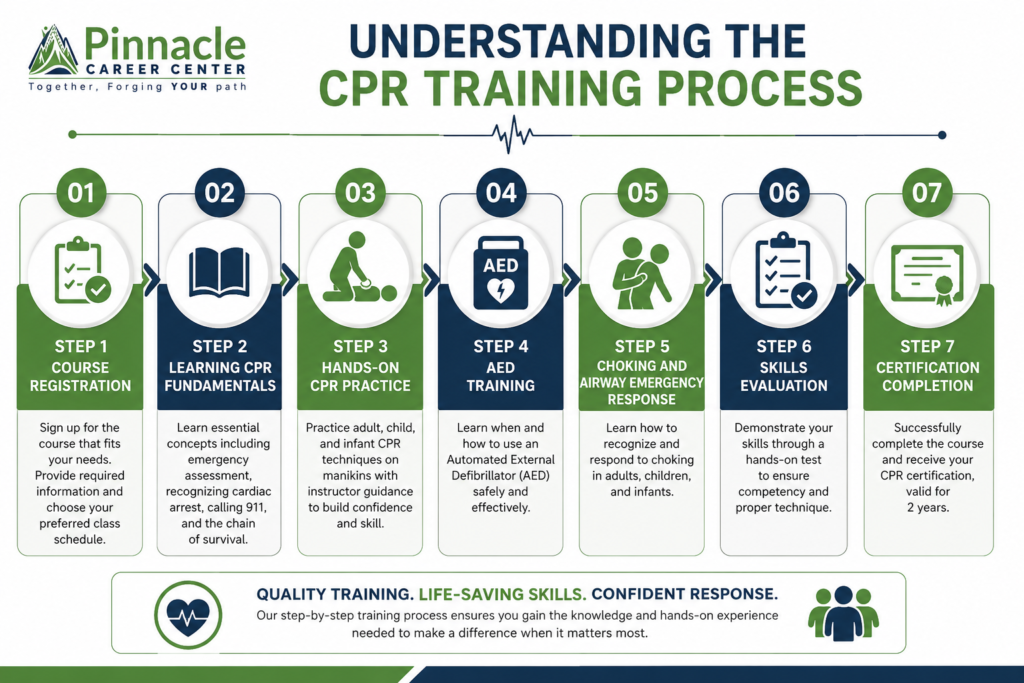
Step 1: Course Registration
Participants select the training option that best matches their needs.
Common choices include:
- Community CPR classes
- Workplace CPR training
- Healthcare provider CPR programs
- First Aid and CPR combination courses
- Renewal courses
- Blended online learning programs
Before enrolling, it’s important to verify that the certification meets employer or licensing requirements.
Step 2: Learning CPR Fundamentals
The instructor begins by covering essential emergency response concepts.
Topics often include:
Recognizing Cardiac Arrest
Participants learn how to identify:
- Unresponsiveness
- Abnormal breathing
- Lack of circulation
- Signs of medical distress
Emergency Activation
Students learn:
- When to call 911
- How to communicate with emergency responders
- Scene safety procedures
- Chain of survival principles
This foundational knowledge helps participants understand when CPR should be initiated.
Step 3: Hands-On CPR Practice
Practical training is one of the most important parts of any CPR Course.
Students practice on CPR manikins while instructors provide guidance and feedback.
Skills include:
Adult CPR
Participants learn:
- Proper hand placement
- Compression depth
- Compression rate
- Body positioning
- Continuous chest compressions
Child CPR
Training addresses age-specific modifications for:
- Compression technique
- Breathing support
- Emergency response considerations
Infant CPR
Specialized instruction focuses on:
- Gentle compression methods
- Infant airway management
- Rescue breathing procedures
Hands-on repetition helps build muscle memory and confidence.
Step 4: AED Training
Most modern CPR programs include instruction on using an Automated External Defibrillator (AED).
Participants learn:
- When an AED should be used
- How to apply electrode pads
- Following device prompts
- Safety precautions
- Coordinating CPR with AED use
AED familiarity is an essential component of emergency preparedness.
Step 5: Choking and Airway Emergency Response
Many CPR classes also include choking response training.
Students learn:
- Adult choking relief techniques
- Child choking interventions
- Infant airway obstruction response
- Recognition of severe airway blockage
These skills address emergencies beyond cardiac arrest situations.
Step 6: Skills Evaluation
Most certification programs require participants to demonstrate competency.
Instructors evaluate:
- Compression quality
- Technique accuracy
- Rescue breathing performance
- AED operation
- Emergency response sequence
The evaluation ensures participants can apply what they learned in a real-world situation.
Step 7: Certification Completion
After successfully completing training and assessment requirements, participants receive CPR Certification.
Most certifications remain valid for:
- Approximately 2 years before renewal is required
Renewal courses are generally shorter because participants already possess foundational knowledge.
Read More: CPR Certification Requirements
In-Person vs Online CPR Training
One factor that affects course duration is the training format.
| Feature | In-Person Training | Online Training |
| Hands-On Practice | Yes | Limited or None |
| Instructor Feedback | Yes | Varies |
| Skills Testing | Included | May Require Separate Evaluation |
| Flexibility | Scheduled Sessions | Self-Paced |
| Completion Speed | Fixed Time | Faster for Some Learners |
| Employer Acceptance | Widely Accepted | Depends on Requirements |
For healthcare and workplace compliance, hands-on training is often preferred because it verifies practical competency.
What Can Affect CPR Course Length?
Several factors influence how long training takes.
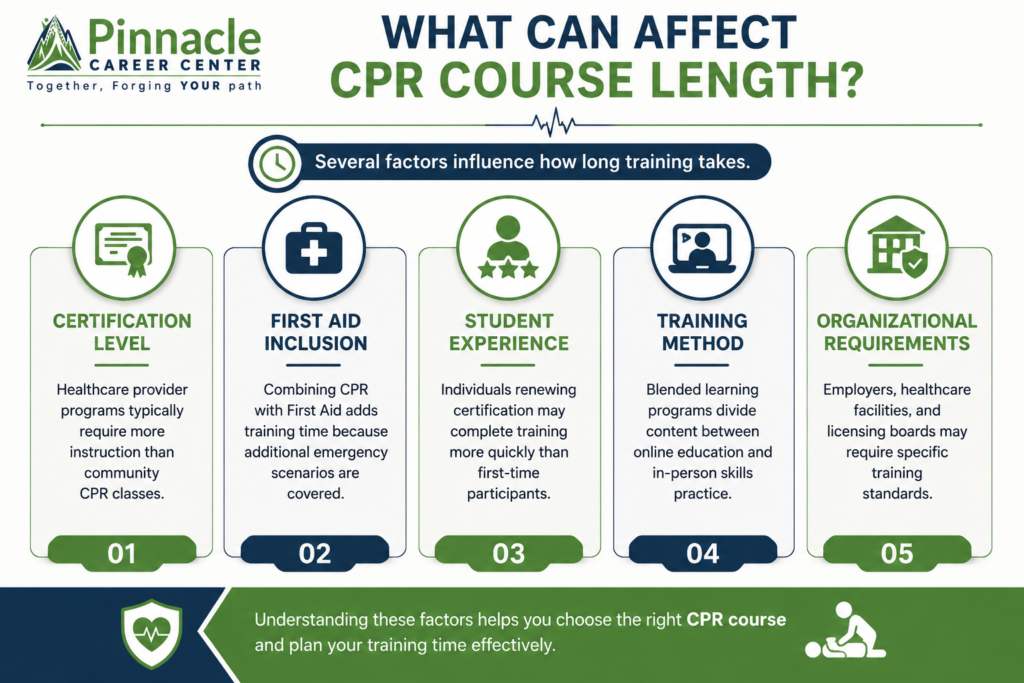
Certification Level
Healthcare provider programs typically require more instruction than community CPR classes.
First Aid Inclusion
Combining CPR with First Aid adds training time because additional emergency scenarios are covered.
Student Experience
Individuals renewing certification may complete training more quickly than first-time participants.
Training Method
Blended learning programs divide content between online education and in-person skills practice.
Organizational Requirements
Employers, healthcare facilities, and licensing boards may require specific training standards.
Who Should Take a CPR Course?
CPR training benefits virtually anyone, but it is especially valuable for:
- Nursing assistants
- Medical assistants
- Healthcare students
- Childcare providers
- Teachers
- Fitness trainers
- Lifeguards
- Security personnel
- Caregivers
- Parents and grandparents
- Workplace safety teams
Even individuals without professional requirements gain important emergency response skills.
What to Bring to CPR Training
Use this quick checklist before attending class:
CPR Training Checklist
✔ Government-issued photo ID
✔ Course registration confirmation
✔ Comfortable clothing
✔ Notebook and pen
✔ Water bottle
✔ Any required prerequisite documentation
✔ Positive attitude and willingness to practice
Being prepared helps maximize your learning experience.
Common Mistakes New CPR Students Make
Many first-time participants encounter similar challenges.
Rushing Chest Compressions
Maintaining proper rhythm is more important than moving too quickly.
Forgetting Full Chest Recoil
Allowing the chest to fully return between compressions improves effectiveness.
Hesitating During Emergency Scenarios
Confidence develops through repetition and hands-on practice.
Skipping Recertification
Life-saving skills should remain current through regular renewal training.
Choosing the Right CPR Training Program
When evaluating providers, consider:
- Instructor qualifications
- Hands-on learning opportunities
- Certification acceptance
- Class flexibility
- Student support
- Training equipment quality
- Employer recognition
For individuals seeking professional training opportunities, programs offered through Pinnacle Career Center provide structured instruction designed to help students build practical emergency response skills and earn recognized CPR Certification.
Those interested in learning more about training options can visit Pinnacle Career Center CPR Program.
Key Takeaways
- Most CPR courses take between 2 and 6 hours.
- Training includes CPR techniques, AED use, choking response, and emergency assessment.
- Hands-on practice is a critical component of effective learning.
- CPR Certification typically remains valid for about two years.
- Course duration varies based on certification level and training format.
- Healthcare-focused programs often require more extensive instruction.
- Choosing a reputable training provider ensures quality education and recognized certification.
FAQs
How long does a CPR course usually take?
Most CPR courses can be completed within 2 to 6 hours, depending on the certification level, course format, and whether First Aid training is included.
Is CPR training difficult?
No. CPR training is designed for beginners and includes instructor guidance, demonstrations, and hands-on practice to build confidence and competence.
Can I complete CPR certification online?
Some CPR Certification programs offer online coursework. However, certain employers and healthcare organizations may require hands-on skills verification.
How often do I need to renew CPR Certification?
Most certifications are valid for approximately two years before renewal is required.
What skills are taught during a CPR Course?
Participants typically learn adult, child, and infant CPR, AED operation, rescue breathing, choking response techniques, and emergency scene assessment.
Is a CPR Course Texas program different from other states?
Core CPR principles remain consistent nationwide, although employer requirements, healthcare regulations, and accepted certification providers may vary by location.
Final Thoughts
A CPR Course is one of the most valuable training investments you can make. In just a few hours, you can learn skills that may help save a life during a medical emergency. Understanding the training process, course duration, and certification requirements allows you to choose the right program with confidence.
Whether you’re preparing for a healthcare career, meeting workplace requirements, or simply wanting to be ready when emergencies happen, quality CPR training provides knowledge and practical skills that can make a meaningful difference when every second counts.