
CNA Written Exam Questions vs Skills Test Questions
Preparing for the CNA certification exam can feel overwhelming at first. Many students complete their CNA classes feeling confident about patient care, only to realize that the certification exam has two very different components. Understanding the difference between CNA written exam questions and skills test questions is one of the most important steps toward passing on your first attempt.
The CNA exam is designed to evaluate both your knowledge and your ability to apply that knowledge in real patient care situations. The written portion focuses on theory, safety principles, and best practices. The skills test measures your hands on performance and ability to follow proper procedures step by step.
If you are currently enrolled in a CNA course or planning to begin CNA training, this guide will help you clearly understand how each section works, what types of questions to expect, and how to prepare effectively.
Related: How Many Questions Are on the CNA Test?
Understanding the CNA Certification Exam Structure
Before comparing the written and skills sections, it is helpful to understand the overall structure of the CNA exam.
Most states divide the certification exam into two parts:
- A written or oral knowledge test
- A practical skills evaluation
Both sections must be passed to become a Certified Nursing Assistant and to be listed on the state nurse aide registry.
While CNA classes prepare you for both areas, they require different study methods and test taking strategies.
CNA Written Exam Questions: What to Expect
The written portion of the CNA exam measures your understanding of core nursing assistant knowledge. This section is typically multiple choice and may include 60 to 100 questions depending on the state.
Some states also offer an oral version for candidates who prefer having the questions read aloud.
Format of the CNA Written Test
Most written exams include:
- Multiple choice questions with four answer options
- Scenario based questions
- Safety and patient care situations
- Basic anatomy and terminology questions
You are usually given a set time limit to complete the test, often between 60 and 90 minutes.
Common Topics Covered in CNA Written Exam Questions
CNA written exam questions focus on theoretical knowledge learned during CNA training. Topics commonly include:
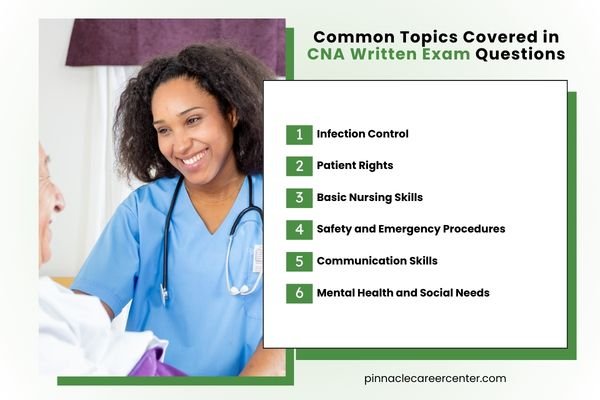
1. Infection Control
You may see questions about hand hygiene, use of gloves, standard precautions, and preventing the spread of disease.
Example:
When should a nursing assistant wash their hands?
2. Patient Rights
Understanding resident rights is critical. Questions may cover privacy, dignity, informed consent, and abuse reporting.
3. Basic Nursing Skills
These questions test knowledge of:
- Measuring vital signs
- Assisting with activities of daily living
- Proper documentation
- Body mechanics
4. Safety and Emergency Procedures
You may be asked about fall prevention, fire safety, choking response, or reporting changes in condition.
5. Communication Skills
Questions often test therapeutic communication techniques and appropriate responses to patients with cognitive impairments.
6. Mental Health and Social Needs
This includes caring for residents with dementia, depression, or anxiety.
How CNA Written Questions Are Designed
The written exam tests critical thinking rather than memorization alone. Many questions are situational.
For example, instead of asking you to define a term, the question may describe a scenario and ask what action you should take first.
This format ensures you can apply knowledge learned in your CNA course to real patient care situations.
Related: CNA Final Exam 100 Questions and Answers Guide
CNA Skills Test Questions: What to Expect
Unlike the written exam, the CNA skills test does not involve answering questions on paper. Instead, you must demonstrate specific clinical skills in front of an evaluator.
This portion assesses your ability to safely perform hands on patient care tasks exactly as taught in your CNA classes.
Structure of the CNA Skills Evaluation
During the skills test:
- You are assigned several skills randomly
- One of the skills will almost always be hand hygiene
- You perform each skill on a mannequin or a partner
- An evaluator observes and checks off required steps
Most states require candidates to perform between three and five skills.
Common Skills Tested on the CNA Exam
While the exact list varies by state, the following skills are commonly tested:
- Handwashing
- Measuring blood pressure
- Taking pulse and respirations
- Assisting with ambulation
- Transferring a patient using a gait belt
- Feeding a resident
- Providing perineal care
- Making an occupied bed
- Assisting with toileting
- Performing range of motion exercises
Your CNA training program should provide a complete checklist of possible skills.
How CNA Skills Test Questions Are Evaluated
Unlike the written exam, the skills test is based on performance and accuracy.
Each skill has critical steps. Missing a critical step often results in automatic failure of that skill.
Critical steps often include:
- Hand hygiene before and after care
- Providing privacy
- Identifying the patient
- Locking wheels on beds and wheelchairs
- Ensuring patient safety and comfort
Evaluators do not give hints or corrections during the test.
Key Differences Between CNA Written Exam and Skills Test
Understanding the differences between these two sections can reduce anxiety and improve preparation.
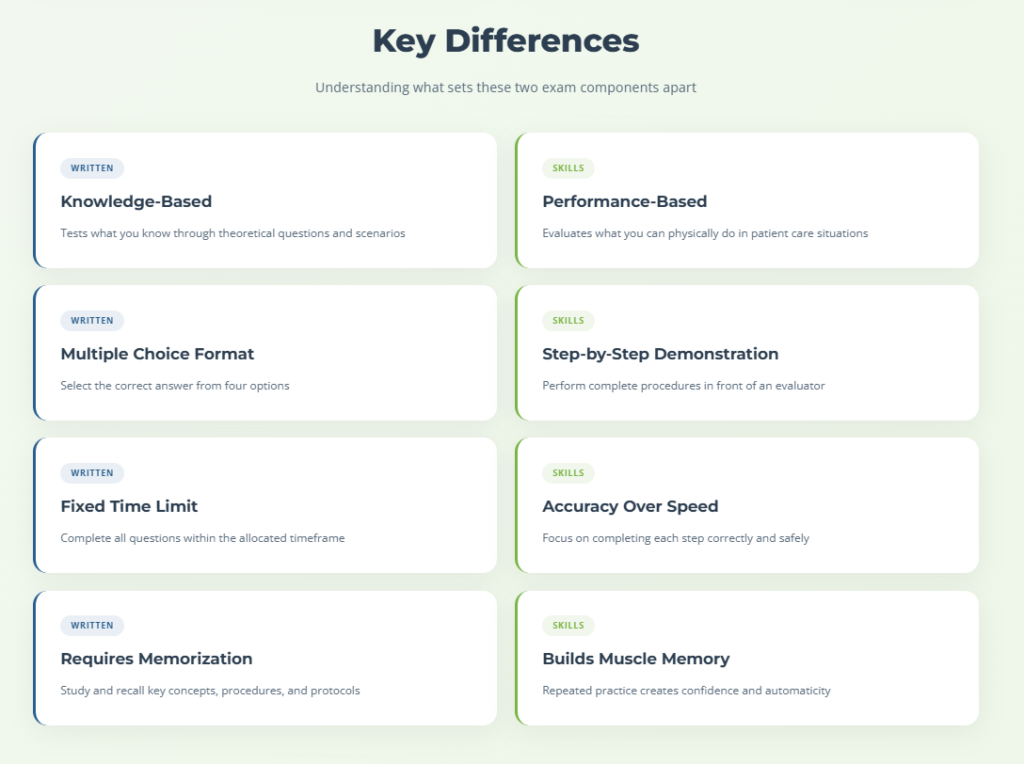
1. Knowledge vs Performance
The written exam tests what you know.
The skills test evaluates what you can physically do.
Both are equally important, but they require different preparation methods.
2. Multiple Choice vs Demonstration
Written exam questions are answered by selecting the correct option.
Skills test tasks require physical demonstration step by step.
3. Time Pressure Differences
Written exams have a fixed time limit.
Skills tests focus more on accuracy than speed, though you must complete tasks within a reasonable timeframe.
4. Memorization vs Muscle Memory
For the written exam, memorizing key concepts helps.
For the skills test, repetition during CNA training builds muscle memory and confidence.
Which Section Is Harder?
Students often ask whether the written or skills portion is more difficult.
The answer depends on your strengths.
If you are comfortable with tests and studying, the written section may feel easier. If you are confident in hands on tasks and patient interaction, the skills test may feel more natural.
Many candidates find the skills exam more stressful because it involves performing in front of an evaluator.
Strong CNA classes focus heavily on skills practice to reduce this anxiety.
How CNA Classes Prepare You for Both Exams
A high quality CNA course prepares you for both components through:
- Classroom instruction for theory
- Skills lab practice
- Clinical experience in real healthcare settings
- Practice exams
- Skills checklists and mock evaluations
CNA training programs are designed to mirror the structure of the state certification exam.
If you are currently searching for CNA classes, look for programs that offer extensive skills lab practice and exam preparation sessions.
Study Tips for CNA Written Exam Questions
To perform well on the written exam, consider these strategies:
Review Core Concepts Daily
Focus on infection control, safety procedures, and patient rights.
Use Practice Tests
Practice questions help you understand the format and identify weak areas.
Read Questions Carefully
Many incorrect answers result from rushing. Pay attention to words like first, best, and most appropriate.
Eliminate Wrong Answers
If unsure, eliminate clearly incorrect options to improve your chances.
Preparation Tips for CNA Skills Test Questions
Preparing for the skills portion requires repetition and confidence.
Practice With a Partner
Simulate the test environment with classmates or family members.
Memorize Critical Steps
Hand hygiene, privacy, safety, and communication are always important.
Speak Clearly During the Test
You must verbalize certain steps, such as explaining procedures to the patient.
Stay Calm
Examiners understand that you are nervous. Focus on completing each step carefully.
Common Mistakes to Avoid
Whether you are preparing through CNA training or self study, avoid these common errors:
Written Exam Mistakes
- Skipping infection control review
- Not practicing scenario based questions
- Overthinking simple questions
Skills Test Mistakes
- Forgetting to wash hands
- Failing to provide privacy
- Not locking wheelchair brakes
- Rushing through the skill
Attention to detail is critical.
Why Both Sections Matter for Your Career
The CNA certification exam ensures that nursing assistants are competent in both knowledge and practical skills.
The written exam ensures you understand why procedures are important.
The skills test ensures you can safely perform those procedures.
Healthcare employers rely on certification as proof that you completed proper CNA training and met state standards.
Final Thoughts
Understanding the difference between CNA written exam questions and skills test questions gives you a clear advantage. The written portion evaluates your knowledge of patient care principles, while the skills test measures your ability to apply those principles in real situations.
Both sections require preparation, practice, and confidence. Enrolling in a structured CNA course and committing to thorough CNA training significantly improves your chances of passing on the first attempt.
If you are serious about becoming a Certified Nursing Assistant, focus on mastering both knowledge and hands on skills. With the right preparation and consistent practice, you can approach exam day with confidence and take the next step toward a rewarding healthcare career.
If you are ready to begin a stable and rewarding career in healthcare, now is the perfect time to take the next step. Pinnacle Career Center is providing a Certified CNA course in San Antonio, TX, designed to give you the hands on training, classroom instruction, and exam preparation you need to succeed.
Join a supportive learning environment, gain real world skills, and prepare with confidence for your CNA certification exam. Contact Pinnacle Career Center today to learn about upcoming class schedules and secure your spot. Your future in healthcare starts here.