

How Many Questions Can You Miss on the CNA Written Exam?
Passing the CNA written exam is a major milestone on the path to becoming a Certified Nursing Assistant. For many students, one of the biggest concerns is not just how hard the exam is, but how many questions can you miss and still pass. This question comes up often among students enrolled in CNA classes, those preparing through a CNA course, and even individuals completing CNA training through employer-sponsored programs.
Understanding how the CNA written exam is scored can ease anxiety and help you prepare more effectively. In this in-depth guide, you will learn how the exam works, how many questions are on it, how scoring is calculated, and what score you need to pass. You will also find practical study tips, common mistakes to avoid, and advice for improving your chances of success on exam day.
Related: CNA Job Descriptions: What Employers Are Looking For
Understanding the CNA Written Exam
Before focusing on how many questions you can miss, it helps to understand the overall structure of the CNA written exam.
The CNA exam is designed to confirm that candidates have the knowledge required to safely care for patients in real-world healthcare settings. This exam is required in all states and is regulated by each state’s nurse aide registry.
Who Administers the CNA Exam?
The CNA written exam is typically administered by third-party testing providers such as:
- Prometric
- Pearson VUE
- Headmaster
Your state contracts with one of these providers, but the exam content follows similar national standards.
How Many Questions Are on the CNA Written Exam?
The number of questions on the CNA written exam varies slightly depending on the state and testing provider.
Typical Number of Questions
In most states, the CNA written exam includes:
- 60 to 70 multiple-choice questions
Some states use 60 questions, while others use 70. A few states may include additional pilot questions that do not count toward your score.
Oral Exam Option
For candidates who have difficulty reading English, many states offer an oral version of the CNA exam. This version includes:
- Spoken questions delivered through headphones
- Additional reading comprehension questions
The scoring rules are generally the same for both written and oral exams.
How Is the CNA Written Exam Scored?
The CNA written exam is scored based on the number of correct answers. Each question is worth one point.
There is no penalty for guessing, so it is always better to answer every question.
Is the Score Based on Percentage?
Yes. Most states require candidates to achieve a minimum passing percentage rather than a specific number of correct answers. The most common passing score is:
- 70 percent or higher
Some states require 75 percent, but 70 percent is the most widely used standard.
Related: What You’ll Do as a Certified Nursing Assistant (CNA)?
How Many Questions Can You Miss on the CNA Written Exam?
Now to the question most students want answered.
If the Exam Has 70 Questions
If your CNA written exam has 70 questions and your state requires a 70 percent passing score:
- You must answer at least 49 questions correctly
- You can miss up to 21 questions
If the Exam Has 60 Questions
If your exam has 60 questions with a 70 percent passing requirement:
- You must answer at least 42 questions correctly
- You can miss up to 18 questions
Important Reminder
These numbers are estimates based on common scoring rules. Some states require higher passing scores, which reduces the number of questions you can miss.
Always confirm your state’s passing requirements through your testing provider or CNA training program.
Does the CNA Written Exam Include Trick Questions?
The CNA exam does not include trick questions, but it does include questions designed to test judgment and safety awareness.
Many students struggle not because the questions are difficult, but because they rush or misread key details.
Common question styles include:
- Best action questions
- Safety priority questions
- Infection control scenarios
- Patient rights situations
CNA classes and a structured CNA course help students learn how to approach these question types confidently.
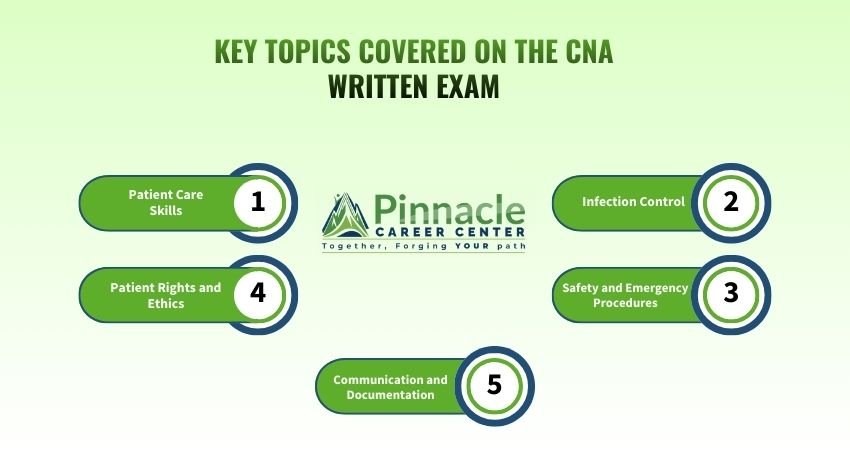
Key Topics Covered on the CNA Written Exam
Knowing what topics appear on the exam can help you focus your study time more effectively.
Patient Care Skills
- Assisting with bathing, dressing, and toileting
- Positioning and transferring patients
- Measuring vital signs
Infection Control
- Hand hygiene
- Use of personal protective equipment
- Preventing the spread of infection
Safety and Emergency Procedures
- Fall prevention
- Fire safety
- Recognizing and reporting changes in patient condition
Patient Rights and Ethics
- Privacy and confidentiality
- Respect and dignity
- Abuse and neglect reporting
Communication and Documentation
- Communicating with patients and healthcare teams
- Proper reporting of observations
These topics are covered in every state-approved CNA training program and reinforced during CNA classes.
Why CNA Classes Mtter for Passing the Written Exam
Many people ask if they can self-study and still pass the CNA exam. While self-study is possible, CNA classes offer several advantages.
Structured Learning
CNA courses are designed to follow the exam blueprint closely. Instructors focus on high-priority topics and common exam scenarios.
Practice Exams
Most CNA training programs include written practice tests that simulate the real exam format. These help students understand timing and question style.
Instructor Guidance
Experienced instructors explain why certain answers are correct and help clarify confusing topics such as patient rights or infection control.
Common Mistakes That Cause Students to Miss Questions
Understanding common mistakes can help you avoid losing points unnecessarily.
Reading Too Quickly
Many exam questions include words like first, best, most appropriate, or immediately. Missing these words can lead to choosing the wrong answer.
Overthinking Simple Questions
The CNA exam focuses on basic care principles. The simplest answer that prioritizes safety is often the correct one.
Forgetting Core Rules
Key rules such as washing hands first, providing privacy, and reporting abnormal findings appear frequently. Missing these basics can cost easy points.
How to Improve Your Score on the CNA Written Exam
If you want to miss fewer questions and feel confident on exam day, preparation is essential.
Use Your CNA Course Materials
Your CNA training textbooks and handouts are aligned with exam content. Review them thoroughly rather than relying on random online resources.
Take Multiple Practice Tests
Practice exams help identify weak areas. Review both correct and incorrect answers to understand the reasoning behind each question.
Focus on Infection Control and Safety
These topics make up a large portion of the exam and are heavily emphasized in CNA classes.
Study a Little Every Day
Short, consistent study sessions are more effective than cramming the night before the exam.
What Happens If You Fail the CNA Written Exam?
Failing the written exam is disappointing, but it is not the end of your CNA journey.
Retake Options
Most states allow candidates to retake the written exam multiple times, usually within a set time frame after completing CNA training.
Do You Have to Repeat CNA Classes?
In most cases, you do not need to repeat your CNA course unless you exceed the allowed number of retakes or your training expires.
Your CNA training provider can guide you on next steps if a retake is needed.
Written Exam vs Skills Exam Scoring
It is important to remember that the CNA exam includes two separate parts:
- Written or oral exam
- Skills exam
You must pass both sections to become certified. Even if you miss very few questions on the written exam, failing the skills test means you will need to retake that portion.
CNA classes emphasize both written knowledge and hands-on skills to ensure full exam readiness.
Final Thoughts
So, how many questions can you miss on the CNA written exam? In most states, you can miss between 18 and 21 questions, depending on the total number of questions and your state’s passing score. However, aiming to miss as few questions as possible should always be your goal.
Strong preparation through a structured CNA course, consistent study habits, and a clear understanding of exam topics can make a significant difference. CNA training is not just about passing a test, but about building the knowledge and confidence needed to provide safe, compassionate patient care.
Pinnacle Career Center offers a comprehensive CNA course in San Antonio, TX, available in both hybrid and on-site formats to fit your schedule and learning style.